
Khalibek Zeinullinovich Bergaripov
Telecommunications engineer, executive and public figure whose name is tied to the history of the Kazsvyazstroy trust and JSC Industrial-Construction Telephone Company BUITELECOM — from the first communication lines to Kazakhstan's National Information Superhighway.
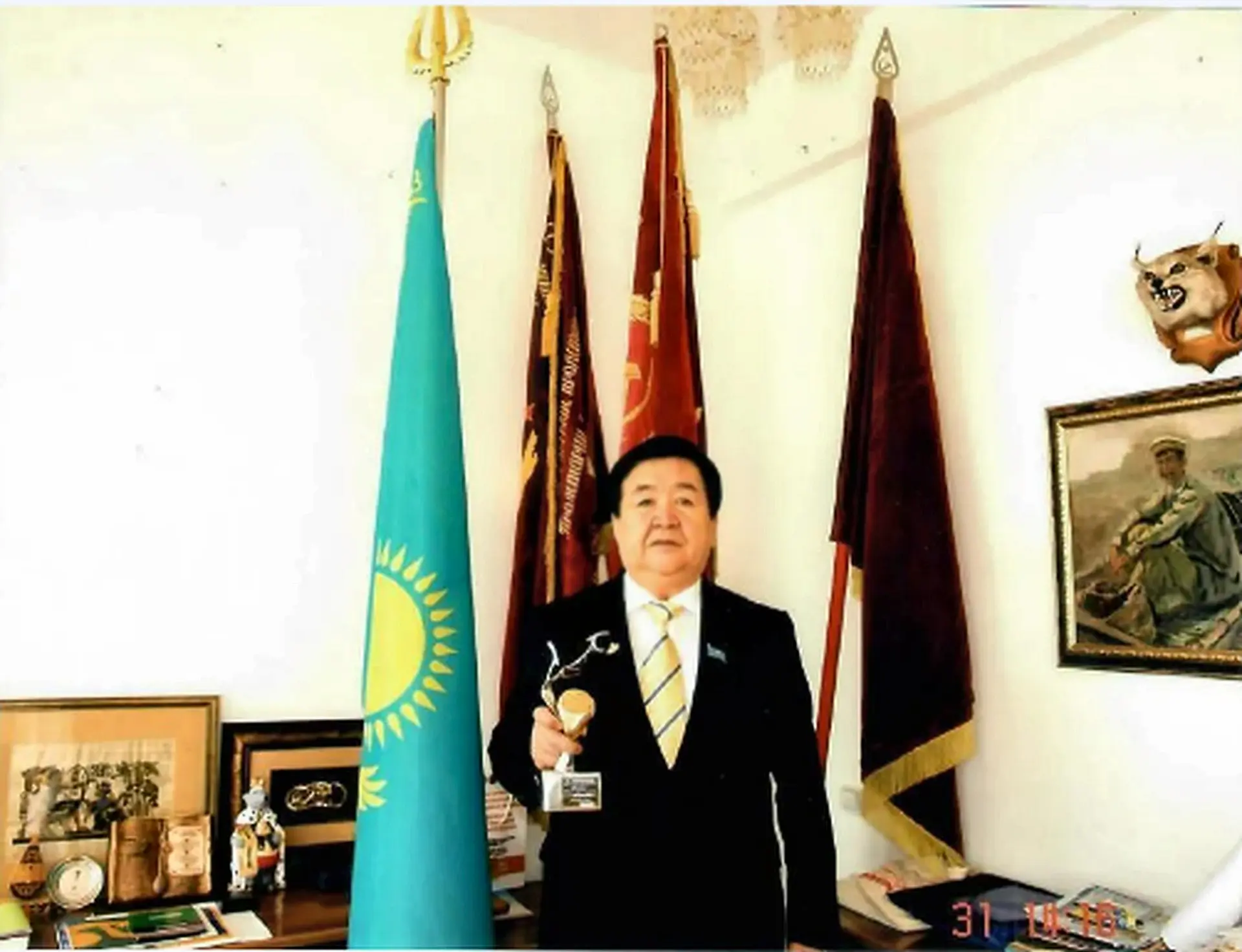
A life devotedto Kazakhstan's communications
Khalibek Zeinullinovich Bergaripov, Founder and First President of the Company, was one of the notable figures in the history of Kazakhstan's telecommunications industry. For more than three decades he led the Kazsvyazstroy trust and its successor organisations, up to JSC Industrial-Construction Telephone Company BUITELECOM.
His professionalism, organisational talent and commitment to technological progress made it possible to preserve and develop the company's workforce, production base and engineering school, while the company's work opened access to modern communications for hundreds of thousands of urban and rural residents.
Student years
From 1964 to 1969 Khalibek Zeinullinovich studied at the Kuibyshev Electrotechnical Institute of Communications (Куйбышевский электротехнический институт связи). He earned good and excellent marks and took an active part in the institute's public life.
He was elected secretary of the institute's Komsomol organisation and led student construction brigades throughout the Middle Volga region. For his academic achievements and public work he was awarded the Certificate of Honour of the USSR Minister of Communications.
From laboratory engineer to head of the trust
After graduating in 1969 he was assigned to Specialised Construction and Installation Trust Kazsvyazstroy No. 1 of the Ministry of Communications of the Kazakh SSR, where he began as an engineer at the construction laboratory. In 1970 he was appointed head of the Aktobe mobile construction unit (PMK) of the Kazsvyazstroy No. 1 trust.
From 1971 to 1973 he served in the Soviet Army. Returning to Kazsvyazstroy No. 1, he worked as deputy chief engineer and then chief engineer, and in 1975 he was appointed manager of the trust.
The continuity of one organisation
In 1988 Khalibek Zeinullinovich became head of the Republican Specialised Construction and Installation Association Kazsvyazstroy, and from 1994 he was President of the organisations successively formed on its basis: State Joint-Stock Company Bailanys-Kurylysshy, CJSC Industrial-Construction Telephone Company BUITELECOM and JSC Industrial-Construction Telephone Company BUITELECOM.
In the early 1990s, during the period of economic transformation, the trust was successfully reorganised into a joint-stock company under his leadership. This was especially significant at the time: the organisational structure, production capacity, jobs, workforce and all divisions were preserved.
- Organisational structure
- Production capacity
- Jobs
- Workforce
- Divisions
A scale that shaped the industry
- 17
- divisions and production facilities
- 100+
- collective and state farms per year
- 150–170k
- exchange numbers per year
- up to 70%
- of annual communications capacity growth
- ≈80%
- of backbone fibre-optic lines designed
Under his leadership the Kazsvyazstroy trust and association comprised 17 divisions and production facilities. According to the historical document, each year on average the organisation built internal communication systems in more than 100 collective and state farms, commissioned automatic telephone exchanges in cities and district centres with a capacity of 150,000–170,000 numbers, as well as cable and radio-relay communication lines.
This accounted for up to 70% of the annual increase in communications capacity of the Republic's Ministry of Communications. The trust repeatedly won All-Union and Republican competitions for high economic and production performance. These figures refer to the historical period described in the document.
The company continued this historical mission: technologies, telecommunications equipment, engineering systems and construction methods were modernised. A dedicated design centre was established within the company; according to the historical document, it designed approximately 80% of Kazakhstan's backbone fibre-optic communication lines. This expanded access to modern telephone communications, telecommunications services and the Internet.
The company's divisions operated in almost every region of Kazakhstan and had a substantial production base — administrative buildings, warehouses, repair workshops, garages, auxiliary facilities and a large fleet of specialised machinery — enabling projects to be delivered across the country.
NISM RK
In 1999, when the Government of the Republic of Kazakhstan decided to build the National Information Fibre-Optic Communications Superhighway of the Republic of Kazakhstan (НИСМ РК / NISM RK), the company actively participated in the design and construction of its segments.
All projects were completed to a high standard and ahead of schedule. Thanks to them, hundreds of thousands of consumers — residents of cities and rural settlements — gained access to modern communications and the Internet.
NISM RK segments and projects
- 01TAE FOCL (ТАЕ ВОЛС)Kazakhstan section of the Trans-Asia-Europe fibre-optic line: Khorgos — Almaty — Taraz — Shymkent — Abai — Uzbekistan border.
- 02CPC (КТК)Communication and telemetry networks for the Caspian Pipeline Consortium — providing communications and telemetry data transmission along the pipeline.
- 03Western segmentShymkent — Aktyubinsk — Atyrau — Russia.
- 04Eastern segmentPetropavlovsk — Akkol — Pavlodar — Astana — Semipalatinsk — Ust-Kamenogorsk — Georgievka.
- 05Northern segmentPetropavlovsk — Kostanay — Rudny.
- 06Fibre-optic lineMakat — Tengiz — Aktau.
The superhighway completed
In July 2007 BUITELECOM, led by company President Khalibek Zeinullinovich Bergaripov, completed construction of Kazakhstan's National Information Superhighway by commissioning the final Aktobe — Uralsk segment.
More than 10,000 km of communication lines were designed and built; the work was carried out by a team of approximately 1,000 employees of JSC ICTC BUITELECOM.
The Spira-Berga plant
- 6
- production lines
- up to 450 mm
- pipe diameter
- 40/32
- telecom pipe — a first in Kazakhstan
- 2010
- 2nd place, Best Product of Kazakhstan
The company was a founder of the Spira-Berga polyethylene pipe plant in Almaty, established under the national import-substitution programme. According to the historical document, the plant operated six modern production lines.
For the first time in Kazakhstan, the plant began producing a 40/32 polyethylene telecommunications pipe with internal longitudinal ribbing and a lubricating internal coating. Its products held Kazakhstani and international quality certificates and complied with the ISO 9001 standard.
In 2009 the second phase of the plant was launched using its own funds — two lines for polyethylene pipes with diameters from 150 to 450 mm — together with modern computer-based measuring and quality-control equipment. In August 2010 the Spira-Berga plant took second place in the Best Product of Kazakhstan (Лучший товар Казахстана) competition.
Plant products and equipment
- 01Telecom pipesPolyethylene pipes for telecommunications infrastructure.
- 02Water and gas supplyPipes for water and gas supply systems with diameters up to 450 mm.
- 03Corrugated pipes110 mm corrugated pipes for household and telephone ducting.
- 04AccessoriesOptional accessories at the customer's choice — couplings and fittings.
- 0540/32 pipePolyethylene telecom pipe with internal longitudinal ribbing and lubricating coating — a first in Kazakhstan.
- 06EquipmentProduction lines supplied by the Austrian company named in the source as CINCINATTI EXTRUSION.
- 07Second phase, 2009Two lines for 150–450 mm polyethylene pipes funded by the company, plus computer-based measuring and control equipment.
First in Kazakhstan
- Navigator
- Kazakhstan's first HDD rig
- 2009
- VERMEER HYDROBURST — trenchless pipe replacement
The company acquired modern equipment from leading international manufacturers for laying fibre-optic communication cables.
According to the historical document, the company was the first in Kazakhstan to acquire a Navigator rig and introduce horizontal directional drilling (HDD) — a technology for installing underground utilities without a conventional open trench.
In 2009 the company acquired and introduced VERMEER HYDROBURST equipment for trenchless replacement of underground pipelines: the existing pipe is broken apart underground and a new pipe is pulled into its place, avoiding major surface excavation. Modern measuring instruments and construction machinery were introduced continuously.
People at the core
Year-round professional development courses were organised at the company — covering modern communications technologies, the safe and efficient operation of equipment, and advanced installation and construction methods. They were attended by employees of the company's divisions, specialists from other organisations and telecommunications professionals from across Kazakhstan, building a professional school for the industry.
Under Khalibek Zeinullinovich's leadership the company maintained a stable workforce. Salaries were paid on time, and employees received the social benefits and guarantees provided under the collective agreement; staff and teams were preserved during the transformation period. Colleagues respected him as a leader who combined professional management with care for people's well-being.
- Timely salaries
- Social benefits
- Employment stability
- Collective agreement guarantees
- Preserved teams
Responsibility to society
- KZT 5,000,000+
- annual sponsorship (historical figure)
Khalibek Zeinullinovich was a deputy of the Almaty City Maslikhat and a member of the Board of Directors of JSC ICTC BUITELECOM.
He supported societies for people with disabilities, children's homes, young artists, writers, and cultural and community initiatives; took part in improving public spaces and neighbourhoods; and helped residents with everyday and social needs. According to the historical document, annual sponsorship assistance exceeded KZT 5,000,000.
Khalibek Zeinullinovich Bergaripov was a deputy of the Almaty city maslikhat: elected to the IV convocation (2007–2012) and continuing as a deputy in the V convocation from 2012.
Company materials also describe him as chairman of the Public Anti-Corruption Council at the Auezov district branch of the Nur Otan party and a member of the bureau of that branch's Political Council.
- Disability societies
- Children's homes
- Young artists
- Writers
- Cultural initiatives
- Neighbourhood improvement
Historical assessment
The historical document describes him as one of the early entrepreneurs whose work helped improve the quality of life of Kazakhstan's population, and notes the respect he earned among Almaty residents and telecommunications professionals across the country.
- High professionalism
- Organisational talent
- Strategic thinking
- Initiative
- Commitment to technological progress
- Patriotism
- Responsibility toward employees
- Care for the public good
Awards and recognition
- 01Order «Знак Почёта» — Badge of Honour
- 02Certificate of Honour of the USSR Minister of Communications
- 03Title «Құрметті байланысшы» — Honoured Communications Worker
- 04Medal «Ерен еңбегі үшін» — For Distinguished Labour
- 05Order «Құрмет» — Order of Honour
- 06Honoured communications worker of the Republic of Kazakhstan
Chronology of life and work
Studies at the Kuibyshev Electrotechnical Institute of Communications; Certificate of Honour of the USSR Minister of Communications.
Construction laboratory engineer, Kazsvyazstroy No. 1 trust, Ministry of Communications of the Kazakh SSR.
Head of the Aktobe PMK, Kazsvyazstroy No. 1 trust.
Service in the Soviet Army; then deputy chief engineer and chief engineer of the trust.
Manager of the Kazsvyazstroy trust.
Head of the Republican Specialised Construction and Installation Association Kazsvyazstroy.
President of SJSC Bailanys-Kurylysshy, later CJSC and JSC ICTC BUITELECOM.
Start of participation in building NISM RK.
Superhighway completed with the Aktobe — Uralsk segment. Elected deputy of the Almaty City Maslikhat, 4th convocation.
VERMEER HYDROBURST introduced; second phase of the Spira-Berga plant.
Spira-Berga takes second place in Best Product of Kazakhstan.
Deputy of the Almaty City Maslikhat, 5th convocation.
«My doors are always open to voters, and when I manage to help them, it is a great joy for me.»
12The founder's legacy
The professional legacy of Khalibek Zeinullinovich Bergaripov lives on in the history of BUITELECOM and in the communication lines that connect Kazakhstan's cities and villages today.
His work remains part of the industry's history — an example of how engineering, responsibility to people and service to the country can come together in a single life.
- The development of BUITELECOM
- Kazakhstan's telecommunications infrastructure
- Expansion of national connectivity
- Technological modernisation
- Industrial innovation
- Professional training
- Preserved jobs and workforce
- Social responsibility
- Contribution to national development
Based on the historical characteristic and company publications. Historical figures do not represent current data.